A Complete Guide for Suppliers
Estimated read time: 18 minutes
Who this is for: Suppliers selling products or services into UK holiday parks, golf clubs, hotels, leisure centres, visitor attractions and other leisure facilities who have purchased, or are considering purchasing, a sector contact list.
You have a list of named decision-makers across UK leisure facilities. What happens next determines whether that investment generates a pipeline of real commercial conversations, or sits in a spreadsheet gathering dust.
Most suppliers who don't get results from B2B contact data make the same mistakes. They use the wrong platform. They send a single email and wait. They write about themselves rather than the decision-maker's world. Or they never send anything at all, paralysed by uncertainty about where to start.
This guide is written specifically for suppliers targeting the UK leisure sector. It draws on 30 years of working with suppliers across security, cleaning, technology, food and beverage, turf, staffing, solar, equipment and more, and the consistent patterns we have observed between campaigns that generate conversations and those that don't.
This is not generic cold email advice. The leisure sector has specific buying behaviours, specific decision-making structures, and specific timing dynamics that generic outreach guides don't address.
Contents
- Why leisure sector data works differently from generic B2B lists
- The platform problem that kills most campaigns before they start
- Technical setup: what you must do before sending a single email
- How to segment your list for better results
- Writing outreach that works for leisure decision-makers
- Sequencing: why one email never moves the needle
- Building a 12-month sector presence vs a one-off campaign
- Postal and telephone: how to use each channel effectively
- What metrics actually matter, and which ones mislead
- Realistic timelines: what to expect at 30, 60 and 90 days
- The most common reasons leisure sector campaigns fail
- FAQs
1. Why Leisure Sector Data Works Differently From Generic B2B Lists
Before covering execution, it is worth understanding why leisure sector outreach is a different discipline from general B2B prospecting, and why this matters for how you use your data.
The sector is not one thing
Generic databases categorise leisure facilities under broad SIC codes like "hospitality" or "recreation." That grouping is commercially useless. A holiday park group with 30 sites has a completely different buying structure from an independent golf club. A local authority leisure trust operates on procurement cycles and budget constraints that bear no resemblance to a private health club chain. A visitor attraction with seasonal revenue peaks makes purchasing decisions at entirely different times of year than a hotel group running year-round occupancy.
When you treat leisure as a single category, your outreach becomes generic, and generic outreach gets ignored.
Decision-makers vary by facility type
At a golf club, the relevant contacts for most suppliers are the Club Manager (operations and overall budget), the Secretary (administration and some procurement), the Greenkeeper (grounds equipment and turf products) and the Catering Manager (food, beverage and equipment). Targeting only one of these roles means missing legitimate budget holders.
At a holiday park, you might need the Park Manager for site-level decisions, a Head Office contact for group purchasing, and Operations or Facilities for maintenance and equipment. A supplier who only contacts the Park Manager at each site misses the group-level conversations entirely.
When your list already maps the right decision-maker to the right facility type, you can write directly to their role and their context, rather than sending a generic message and hoping it lands. That is what sector-specific, profiled data delivers.
Leisure facilities have distinct seasonal buying patterns
Holiday parks make the majority of capital investment decisions between October and February, during the off-season, when parks are closed or quieter and managers have headspace for supplier conversations. Approaching a holiday park in July with a non-urgent sales message is likely to be ignored; they are at peak occupancy and focused entirely on operations.
Golf clubs make significant purchasing decisions in autumn, driven by the end-of-season budget review cycle. Hotels are more year-round but are often receptive to conversations in January, at the start of the new budget year, and in August, when planning for autumn and winter begins.
Knowing this changes when you send, not just what you send.
2. The Platform Problem That Kills Most Campaigns Before They Start
Never send cold outreach through Mailchimp, Campaign Monitor, Klaviyo, Dotdigital, or any similar email marketing platform.
These tools are built for sending to opted-in subscribers: newsletters, promotional campaigns, customer communications. Their terms of service explicitly prohibit unsolicited cold outreach. More importantly, they share sending infrastructure across thousands of users. If any of those users sends spam, the shared IP reputation suffers, and so does your deliverability.
The practical consequences of using the wrong platform are not theoretical:
- Your Mailchimp account will be suspended, often without warning and often permanently
- Your sending domain (yourcompany.co.uk) can be blacklisted across major email providers
- Once blacklisted, legitimate emails to existing clients may not be delivered
- Recovering domain reputation takes weeks or months, and sometimes it never fully recovers
- This affects your entire business email operation, not just the outreach campaign
A supplier who has bought a compliant B2B leisure sector list and is running lawful outreach under Legitimate Interest can still damage their business irreparably by using the wrong tool. The compliance issue is separate from the technical infrastructure issue. You can be fully compliant with data protection law and still ruin your domain reputation by sending through a platform not designed for cold outreach.
What to use instead
Cold outreach tools are built specifically for B2B prospecting. They manage separate sending domains, handle mailbox warm-up, rotate sending across multiple inboxes, and are designed for the technical realities of cold email at scale. The most commonly used options are Instantly, Saleshandy, Smartlead, Lemlist and Woodpecker. Each works; the differences are largely in interface and pricing rather than fundamental capability. Any of them will outperform any email marketing platform for this purpose.
3. Technical Setup: What You Must Do Before Sending a Single Email
Getting the technical foundation right is not optional. Skipping any of these steps will reduce your deliverability, sometimes significantly.
Set up a dedicated sending domain
Do not send cold outreach from your primary business domain. Your primary domain (yourcompany.co.uk) is your most valuable digital asset. Client communications, supplier emails, team correspondence and your website all flow through it. If that domain develops a poor sender reputation through cold outreach activity, even a well-run campaign, those existing communications risk landing in spam.
Register a closely related domain specifically for outreach:
- yourcompany-team.co.uk
- getyourcompany.co.uk
- yourcompanygroup.co.uk
Keep it close enough to your brand to be recognisable, but distinct enough that reputation effects don't transfer. Cost: approximately £10 to £15 per year.
Configure SPF, DKIM and DMARC records
These are three DNS settings that authenticate your emails and tell receiving mail servers your messages are legitimate. Without them, your emails will be heavily filtered or blocked.
- SPF (Sender Policy Framework) tells receiving servers which mail servers are authorised to send on behalf of your domain.
- DKIM (DomainKeys Identified Mail) adds a digital signature to every email, verifying it hasn't been tampered with in transit. Your cold outreach tool will usually generate this automatically.
- DMARC (Domain-based Message Authentication, Reporting and Conformance) tells receiving servers what to do if SPF or DKIM checks fail. Start with a policy of "none" to monitor, and tighten it over time as your reputation builds.
Your cold outreach tool will provide step-by-step instructions for all three. If you're not comfortable with DNS settings, any competent IT contact or web developer can complete this task.
Warm up your sending domain
A new domain has no sending history. Sending 500 emails from a brand-new setup immediately triggers spam filters, because the behaviour pattern matches exactly what a newly registered spam domain would do.
Email warm-up is the process of gradually building your sender reputation by slowly increasing volume over several weeks. Most cold outreach tools automate this. Enable it before you send anything, and follow this rough timeline:
PeriodDaily volume per mailboxActivityWeek 1-25-15 emailsAutomated warm-up only. No campaign emails.Week 315-25 emailsWarm-up continues. Begin small test batches (10-20 contacts).Week 425-40 emailsRamp up to controlled campaign volume.Week 5 onwards30-50 emailsFull campaign at sustainable volume. Keep warm-up running.
Keep warm-up enabled permanently, not just during the initial period. It protects your sender score on an ongoing basis.
Safe daily sending limits
Never exceed 50 emails per day from a single inbox. This is consistent guidance from deliverability specialists across the industry.
If you want to reach more contacts per day, the answer is more mailboxes, not higher volume per mailbox. Four mailboxes gives you a safe daily volume of 120 to 200 emails. Eight mailboxes gives you 240 to 400 emails per day. At four mailboxes sending 150 emails per day, across 20 working days per month, you can work through approximately 3,000 contacts per month. A list of 2,500 records takes 4 to 6 weeks to cover at that pace, which is exactly right.
4. How to Segment Your List for Better Results
With a sector-specific leisure list, you already have a significant advantage: the facilities are pre-defined and the contacts are mapped by role. How you segment within that list makes a significant additional difference.
Segment by facility type, not geography
Geography is a convenient way to think about segmentation but it is rarely the most commercially useful one. A holiday park in Cornwall and a holiday park in Yorkshire have far more in common operationally than a holiday park and a hotel that share the same postcode. Segment by facility type first, then apply geographic filters only where your product genuinely varies by region, for example landscape contractors or regional food suppliers.
Segment by decision-maker role
Different roles have different buying motivations and use different language. A Greenkeeper cares about performance, product reliability and practical application. A GM at a hotel group cares about terms, supplier stability and volume pricing. A Club Manager at a golf club cares about member experience and operational impact.
Write to the role, not to a generic "Decision-Maker." Your list already gives you this information.
Prioritise by best-fit first
Not all records in your list represent equal commercial opportunity. If you sell a product most relevant to facilities with swimming pools, start with those. If your product suits large sites, prioritise by number of pitches or rooms. This front-loads your campaign with the most receptive recipients and generates early signals about message resonance before you reach the broader list.
Multi-site operators vs independents
Multi-site leisure operators, including holiday park groups, hotel chains and health club chains, have centralised purchasing at head office level alongside site-level operational decisions. The right contact for a group-level conversation is different from the right contact for a site-level conversation, and the message is different too.
Your Leisure Lists data can include head office contacts for group operators. Use these for strategic, group-level conversations, and site-level contacts for operational product discussions, or to apply pressure on their head office network.
5. Writing Outreach That Works for Leisure Decision-Makers
Platform and infrastructure get your emails delivered. What you write determines whether they generate replies.
Lead with their world, not yours
A General Manager at a mid-sized holiday park group receives supplier emails every day. Most open with some version of: "Hi [Name], I'm reaching out because we provide [product/service] to leisure businesses like yours…" followed by several paragraphs about the sending company.
This approach asks the recipient to do cognitive work: to translate what you do into whether it's relevant to them, right now, with no context established. Most people don't do that work. They will likely move on.
What works is demonstrating immediately that you understand their specific situation, not "the leisure sector" generically, but the operational, commercial or seasonal context of their particular facility type. This signals that your message is worth reading before you have asked them to believe anything about your product.
What changes by facility type
If you sell cleaning products or hygiene supplies:
Generic version (doesn't work):
"Hi [Name], we supply professional cleaning solutions to leisure businesses across the UK. Our COSHH-compliant range is trusted by hundreds of clients…"
Facility-specific version (works better):
To a holiday park manager: "The turnaround window between departures and arrivals on changeover day is one of the biggest operational pressure points in park management. We have built our range specifically around that constraint. Do you have a supply arrangement you are happy with, or is it something you review each year?"
To a golf club manager: "Locker rooms and changing facilities are the area most members notice, and the standard of cleaning there directly affects membership retention. Are your current protocols meeting the standard you would want?"
To a leisure centre operator: "Poolside environments bring a specific challenge: cleaning chemistry has to work effectively while remaining compatible with the water treatment regulatory environment. Is that something your current supplier helps you navigate?"
Same product. Three different messages. Each demonstrates immediate relevance to the recipient's specific context.
Subject lines for cold outreach
Subject lines serve one purpose: to earn the open. They should be short, human and specific, and should not look like marketing.
Approaches that work:
- A specific observation relevant to their role: "Holiday park changeover logistics"
- A contextual question: "Golf club supplier for [specific product category]?"
- A role reference: "Re: leisure centre procurement"
- A peer reference: "What other hotel managers are doing on [topic]"
Approaches that don't work as well:
- Anything with "exclusive", "opportunity", "partnership" or "boost your ROI"
- Your company name in the subject line
- Generic curiosity-bait like "Quick question…" which is overused and now signals spam
- Anything over seven or eight words
Emails with six to eight sentences consistently perform well, and messages under 200 words tend to outperform longer ones in cold outreach contexts.
Keep early emails short
Your first email should be under 150 words. This is a discipline, not a limitation. You are not trying to explain everything you offer. You are trying to earn one reply: one observation, one question, one ask. Everything else comes after the conversation has started.
6. Sequencing: Why One Email Never Moves the Needle
Leisure sector decision-makers are busy, often operationally focused, and frequently moving between sites or attending trade events. A single cold email to a cold contact will not reliably generate pipeline.
A structured sequence over several months will.
The reason is timing, not persistence. The decision-maker who ignores your first email in October may be exactly the right person, but they are in the middle of season close-out, dealing with staff departures and maintenance backlogs. The same email in November lands differently. Your sequence keeps you visible until the timing is right.
Step 1, Day 1: The diagnostic opening
Lead with a specific observation about their facility type or role. Ask one relevant question. Do not mention your product or company. Under 120 words. The goal is to earn a reply and establish that you understand their world.
Step 2, Day 5 to 7: Proof and context
Briefly introduce who you are and what you do, but frame it as relevant context for the observation in step 1, not as a product pitch. Add one credibility point: sector experience, relevant client examples, or a specific capability relevant to their facility type. The goal is to add credibility to the conversation you opened.
Step 3, Week 3: Commercial framing
Introduce a commercial tension relevant to their situation: the difference between how most suppliers approach this category and what a more structured approach looks like. Offer a specific, low-friction next step such as a sector overview, a sample or a short call. The goal is to create a reason to move from awareness to action.
Step 4, Week 6 to 7: The advisory email
Share a broader observation about how suppliers in this segment are approaching the market. Reference something seasonally relevant where possible, such as "with most parks coming into their planning period" or "with the season winding down." This positions you as someone who understands the sector rather than just someone selling into it.
Step 5, Week 10 to 12: The clean close
Keep it short and confident. Acknowledge that the timing may not be right and leave the door open without pressure. Under 80 words. The goal is to preserve the relationship and make re-engagement easy when the timing does become right.
7. Building a 12-Month Sector Presence vs a One-Off Campaign
The 5-step sequence above is the engine. This section is about how long you run it, and why that decision matters as much as the quality of your messaging.
There is an important distinction between a sequence and a programme. A sequence is one structured pass through a list over 8 to 12 weeks. A programme is multiple sequences, timed to the buying calendar, running over 6 to 12 months. Both require the same infrastructure and messaging discipline. The difference is what you are building towards.
The core problem with one-off campaigns in the leisure sector
Most leisure facility types make significant supplier decisions once per year, in a defined window.
Holiday parks between October and February. Golf clubs in September through November. Local authority leisure trusts tied to municipal budget cycles.
A supplier running a single 10-week campaign has roughly a 20% chance of hitting that window for any given facility. There is an 80% chance the campaign runs at the wrong time, and the decision-maker who would have been genuinely interested simply wasn't in a position to act.
That is not a messaging failure. It is a timing failure, and the only reliable fix is sustained presence.
How the leisure buying calendar shapes a 12-month programme
The leisure sector has a more defined annual rhythm than most B2B markets. Understanding it allows you to build outreach that works with that rhythm rather than against it.
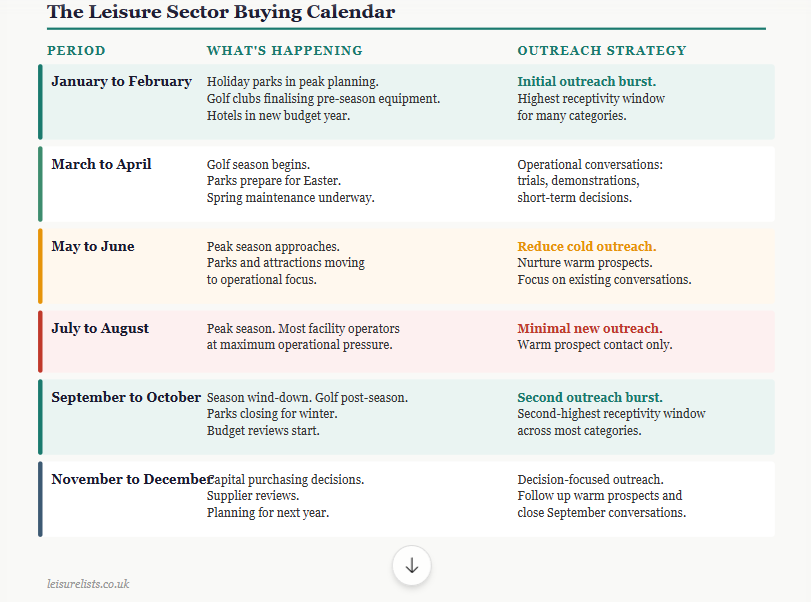
January to February Holiday parks are in their peak planning period. Golf clubs are finalising pre-season equipment. Hotels are in the new budget year. This is the initial outreach burst window and the highest receptivity period for most supplier categories.
March to April Golf season begins. Parks prepare for Easter. Spring maintenance gets underway. This is the time for operational conversations: product trials, demonstrations and shorter-term decisions.
May to June Peak season approaches. Parks and attractions shift to full operational focus. Reduce cold outreach and focus on nurturing warm prospects already in conversation.
July to August Peak season. Most facility operators are at maximum operational pressure. Keep new cold outreach to a minimum. Maintain contact with warm prospects only.
September to October Season wind-down begins. Golf enters its post-season. Parks start closing for winter and budget reviews begin. This is the second outreach burst window, the second-highest receptivity period across most categories.
November to December Capital purchasing decisions are being made. Supplier reviews are underway. Facilities are planning for next year. Focus on decision-oriented outreach, following up warm prospects and closing conversations opened in September.
A supplier who runs one campaign from March through May will see modest results: they catch a subset of facilities in the right window and miss the majority. A supplier running a structured 12-month programme works through the full list twice, times the peaks to the two highest receptivity windows, and uses the quieter summer period for nurturing rather than cold outreach. The difference in pipeline generated is not marginal.
What a 12-month programme looks like in practice
Months 1 to 2: Infrastructure setup, domain warm-up, initial outreach burst to priority segments. Full 5-step sequence launched. Goal: establish a pipeline of early conversations before the spring operational rush.
Months 3 to 4: Outreach continues for warm prospects. Cold outreach volume reduced. New conversations being progressed. Segments that responded well in the burst phase get targeted follow-up.
Months 5 to 6: Summer taper. Outreach volume deliberately reduced for most facility types. Warm prospects maintained with low-frequency, high-relevance contact. Use this period to refine messaging based on what worked in months 1 to 4.
Months 7 to 8: Autumn burst. Second full sequence launched to the original list, with refined messaging based on earlier campaign signals. Contacts who didn't reply in January to February are re-approached with updated copy. Contacts who said "not now" in spring may be ready now.
Months 9 to 10: Peak decision period. Full focus on progressing warm prospects toward active conversations. New outreach to segments not yet fully covered.
Months 11 to 12: Year-end follow-up. Progress as many active conversations as possible before the Christmas slowdown. Begin planning the following year's programme using 12 months of response data.
Why this model produces compounding results:
A single campaign generates pipeline in a narrow window.
A 12-month programme generates pipeline continuously, because different facility types within the leisure sector are always in a receptive phase somewhere in the calendar.
Holiday parks are planning while golf clubs are mid-season. Hotel groups run year-round while visitor attractions wind down. A programme timed to cycle through segments in rhythm with their individual buying calendars means you are never entirely out of season.
There is also a recognition effect that builds between months 4 and 8. A decision-maker who received and ignored your first sequence in January may recognise your name when your autumn sequence arrives in September.
Familiarity lowers the threshold for engagement, and the second pass through the same list consistently outperforms the first, not because the messaging is better, but because you are no longer a completely cold contact.
Campaign thinking vs programme thinking
Campaign thinking: spend budget, run outreach, evaluate results, repeat if it worked.
Programme thinking: build a presence in a defined market, maintain it consistently, and let timing work for you rather than against you.
The leisure sector rewards the second approach disproportionately. The suppliers who consistently win new leisure clients are not necessarily running better individual campaigns. They are simply still visible when their prospects are finally ready to buy.
8. Postal and Telephone: Using Each Channel Effectively
Email outreach is the highest-volume, lowest-cost channel for most suppliers. Postal and telephone serve different and complementary purposes, and for leisure sector outreach specifically, both retain real relevance.
When postal campaigns work well
Direct mail has experienced a quiet resurgence in B2B outreach, precisely because the email channel has become noisier. A well-produced printed piece arriving at a leisure facility stands out in a way that an email does not.
Postal works particularly well for:
- Initial awareness campaigns before or alongside email sequences, particularly for higher-value products where brand familiarity matters
- Exhibition or event follow-up, where a physical piece sent after meeting someone at a trade show reinforces the conversation and builds trust
- Seasonal timing, where a mailer landing in October or November, when holiday parks are in planning mode and golf clubs are reviewing budgets, can open conversations that email alone might not
Postal accuracy matters more than in email outreach, because wasted postage on inaccurate records is a direct cost.
The Leisure Lists postal guarantee, which credits £1 per inaccurate record reported within six weeks, exists precisely because postal accuracy directly affects campaign ROI.
When telephone outreach works well
Telephone outreach is the highest-friction, highest-reward channel. It generates direct conversations but requires more resource and careful timing.
For leisure sector suppliers, telephone works best in two situations.
First, following up email sequences where engagement is already visible. If a contact has opened your emails multiple times without replying, a relevant phone call referencing the email thread can convert passive interest into a conversation. The sequence warms the call; the call converts the warmth.
Second, when targeting independent operators, where the decision-maker is typically the owner or manager and direct conversation is often how they prefer to buy. Small, independent holiday parks, golf clubs and visitor attractions often have one primary buyer, and a well-timed, knowledgeable phone call from someone who clearly understands their sector carries real weight.
All Leisure Lists telephone data is screened against TPS (Telephone Preference Service) and CTPS (Corporate Telephone Preference Service) registers, which is a legal requirement for outbound telephone marketing in the UK.
Using all three channels together
The most effective campaigns use multiple touches across different channels. Email establishes familiarity and context. A targeted postal piece reinforces brand presence physically. Telephone follow-up with the most engaged or highest-value prospects converts that presence into active conversations.
Your Leisure Lists data lease can be crafted to cover all three channels. You do not need separate purchases from different suppliers to run a multi-channel campaign.
9. What Metrics Actually Matter, and Which Ones Mislead
A significant number of suppliers make campaign decisions based on the wrong signals. Here is a clear breakdown.
Metrics that matter
Reply rate is the primary indicator of whether your messaging is resonating. It includes all replies: positive interest, requests for information, "not right now" and unsubscribes. A combined reply rate of 3 to 8% is typical for a well-structured campaign targeting a defined sector.
Positive reply rate is the subset of replies expressing genuine interest. For cold outreach into a new sector, 1 to 3% is realistic. Well-personalised, targeted emails can push this toward 5 to 7%, but that requires strong list segmentation and facility-specific messaging. If you are at the lower end of the range, it is a signal to refine your approach, not to abandon it.
Conversation-to-meeting rate tells you how effectively you are converting positive replies into live conversations. A low positive reply rate with a high conversion rate suggests your messaging is highly targeted but reaching too narrow an audience. A high positive reply rate with low conversion suggests the initial hook is working but the follow-up isn't.
Pipeline generated at 60 and 90 days is the ultimate business metric. Cold outreach is not a fast channel. Meaningful pipeline visibility typically emerges at the 8 to 12 week mark, not at two or three weeks.
Metrics that mislead
Open rate has been unreliable since Apple's Mail Privacy Protection update, which pre-loads email content regardless of whether the recipient actually opened it. Open rates are now inflated by machine opens and should not drive meaningful decisions. Many deliverability specialists recommend disabling open tracking entirely for cold outreach, as the tracking pixel provides little useful signal and can marginally affect deliverability.
Send volume is not a performance metric. High send volume with poor reply rates means you are efficiently generating noise. Slow down, fix the messaging, then scale.
Bounce rate matters as a data quality signal: consistent hard bounces above 2% suggest issues that need addressing. It is not, however, a campaign performance metric in itself.
10. Realistic Timelines: What to Expect at 30, 60 and 90 Days
One of the most common reasons suppliers abandon outreach campaigns too early is misaligned expectations about timelines. These are honest benchmarks for leisure sector outreach specifically.
Weeks 1 to 2: Infrastructure only
If you are setting up from scratch, the first two weeks should be entirely focused on domain setup, DNS configuration, platform configuration and warm-up. Do not send any campaign emails during this period. Doing so undermines warm-up and risks damaging deliverability before your campaign has properly started.
Weeks 3 to 4: Soft launch
Begin with a small initial batch, 50 to 100 contacts maximum, to test your sequence and identify any technical issues before committing to volume. Review reply rates, check spam placement, and refine subject lines and opening sentences based on early signals.
Day 30: Early signals
You will begin to see early reply patterns: positive replies, unsubscribes, and requests for more information. Positive reply rates at this stage will typically be lower than they will be at month 2, because most contacts are still in the early steps of your sequence. Avoid making major strategic decisions based on month-one data alone.
Day 60: Meaningful data
By day 60, your earliest contacts are reaching steps 3 to 5 of your sequence, and you have enough data to make meaningful observations.
Which subject lines are generating more replies? Which facility types or decision-maker roles are most responsive? Which messaging angle is landing?
Use this to refine the remainder of your campaign rather than starting over.
You should also begin to see your first qualified conversations: contacts who replied positively and are now in a dialogue or have agreed to a call.
Day 90: Pipeline visibility
At 90 days, a well-run leisure sector campaign should have a visible pipeline at various stages. Some contacts will have converted to meetings or proposals. Some will be warm but timing-delayed. Some will have indicated interest for a later period.
The contacts who said "not right now" in month one become relevant again in month three as your sequence extends and as seasonal timing shifts in your favour.
11. The Most Common Reasons Leisure Sector Campaigns Fail
Based on 30 years of supplying data to leisure sector suppliers, these are the failure patterns we observe most consistently.
Treating leisure as one market. Holiday parks, golf clubs, hotels, leisure centres, visitor attractions and sporting venues have different operational structures, different buying roles, different seasonal patterns and different commercial pressures. One generic message sent to all of them will resonate with none of them reliably.
Sending from the primary business domain. As covered in section 2, this is the fastest route to damaging your overall business email operation. Always use a dedicated sending domain.
Using an email marketing platform for cold outreach. Mailchimp, Campaign Monitor and similar tools are not designed for this use case and their terms of service prohibit it. Account suspension and domain blacklisting are real and common consequences.
Running a single-email campaign. The majority of positive replies in a well-run sequence come from steps 3 to 5, not step 1. Stopping after the first send means walking away from most of the pipeline.
Copying generic B2B outreach templates. Templates written for SaaS sales into tech companies do not translate to suppliers selling physical products or services into leisure facilities. The buying context, the decision-maker's daily reality and the language of the sector are entirely different.
Ignoring seasonal timing. Approaching holiday parks in July, golf clubs at the start of the playing season, or leisure centres when their annual budget has just been set are the hardest times to open a new supplier conversation. Timing your outreach to match planning and procurement cycles makes a measurable difference to results.
Evaluating too early. Assessing a campaign after two weeks is like checking whether seeds have grown the day after planting them. The metric at two weeks is infrastructure performance, not commercial results. Give any campaign at least 90 days before drawing conclusions.
12. Frequently Asked Questions
How long does it take to see results from a leisure industry contact list?
Realistic pipeline visibility typically emerges at 60 to 90 days from campaign launch. The first replies often appear within 2 to 4 weeks, but converting those replies into meetings and proposals takes longer. Allow for a minimum 3-month campaign horizon before evaluating results.
How long should I run a leisure sector outreach campaign?
The minimum for a meaningful single sequence is 10 to 12 weeks, long enough to complete a 5-step follow-up series with your full list. For sustainable pipeline, a 6 to 12 month programme is significantly more effective. Leisure sector buying decisions are annual and concentrated into short windows, and a 12-month programme means you are present for both the January to February and September to October peaks. Suppliers who run 12-month programmes consistently outperform those running repeated one-off campaigns, partly through better timing alignment and partly through the familiarity that builds between the first and second pass through a list.
Can I use my leisure sector data for a postal campaign alongside email?
Yes. Your Leisure Lists lease can cover the data across channels, including email, postal and telephone, depending on your contract. Multi-channel campaigns consistently outperform single-channel ones. Running an email sequence in parallel with a targeted postal piece to the same decision-makers reinforces both. Adding on additional channels can be facilitated to accompany your original lease.
What is the difference between a single-use and a leased data licence?
Single-use data allows one outreach communication to the list. A 6 or 12-month lease allows unlimited contacts within the licence period. Given that effective outreach typically requires 4 to 5 touchpoints over 8 to 12 weeks, a leased licence is almost always the right choice for email outreach. Single-use is more relevant for one-off postal campaigns where the economics are different.
Can I target head office contacts for multi-site operators separately from individual sites?
Yes. The Leisure Lists database includes head office contacts for major group operators across holiday parks, hotel chains, health club groups and more. These can be selected separately and are appropriate for group-level conversations. Site-level contacts are better suited to operational, product-specific outreach.
What should I do if a contact replies to say they are not interested?
Remove them from your sequence immediately and note the response. A high proportion of "not interested" replies from a particular facility type or role can indicate a messaging mismatch rather than a genuine absence of market demand. Revisit the approach for that segment before writing it off.
Is it legally compliant to email cold contacts from a leisure industry list?
UK GDPR allows B2B cold email outreach under the Legitimate Interest lawful basis, provided the communication is relevant to the recipient's professional role and is proportionate. Suppliers using a Leisure Lists contact list to reach decision-makers in a relevant professional capacity are engaged in lawful B2B prospecting. You must include a clear opt-out mechanism in every email. Full compliance guidance is available on our blog.
Summary: 13 Things That Separate Campaigns That Work From Those That Don't
- Use a dedicated sending domain, never your primary business domain
- Use a cold outreach tool, not an email marketing platform
- Set up SPF, DKIM and DMARC before you send anything
- Warm up your domain for 3 to 4 weeks before launching at volume
- Segment by facility type and decision-maker role, not geography
- Write to the specific context of each facility type, not to "the leisure sector" broadly
- Run a structured sequence of 4 to 5 steps over 8 to 12 weeks, not a single send
- Time your outreach bursts to the buying calendar: January to February and September to October are the highest-receptivity windows for most leisure categories
- Use the quieter summer period to nurture warm prospects rather than pushing cold outreach
- Think in programmes rather than campaigns: a 12-month presence compounds in ways a single campaign cannot
- Use postal and telephone to reinforce and complement email, not replace it
- Measure reply rate and pipeline generated at 90 days, not open rate
- Commit to at least 90 days before drawing conclusions about results
About Leisure Lists
Leisure Lists has supplied B2B contact data to suppliers selling into the UK leisure sector for over 30 years. Our database covers 100,000 named decision-makers across 21 defined leisure facility types, including holiday parks, golf clubs, hotels, leisure centres, visitor attractions, health and fitness clubs, spas, swimming pools, universities and more.
Data is available for email, postal and telephone outreach on flexible 6 and 12-month lease terms.
If you would like guidance on which sectors and decision-maker roles are most relevant for your product or service, or if you would like to discuss Outreach Engine, our managed programme service, contact the team at info@leisurelists.co.uk or call 01638 730976.
Leisure Lists' Blog